Showing posts with label Humber college. Show all posts

Saturday, 26 April 2014

Thesis: Centre for The Visually Impaired - The Design 2

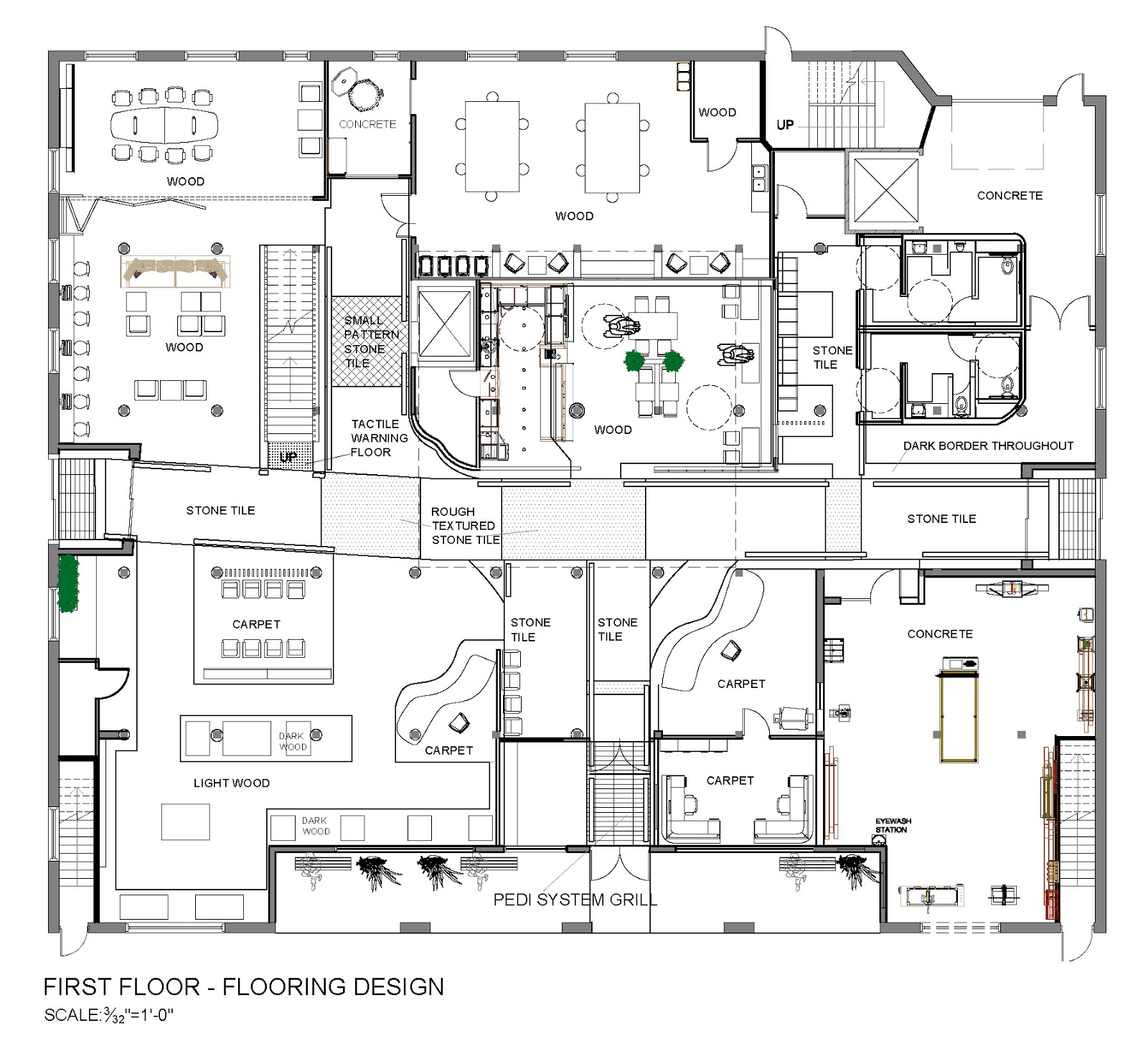
The Plans & Sections


Section 1

Section 2

Section 3

Section 4


Renderings


A strong contrast of colour and materials

Main Entrance


The Cafe


Tactile Art in Bronze in the Cafe

Tactile Clay Art on the curved wall leading to the Clay Studio

The Retail/Gallery displaying student work


Tactile Art in Wood outside the Wood Workshop


The lounge & meeting room behind it - The Business Centre

Staircase leading to Second Floor


The Staircase - It reaches up to the roof and has a skylight


The Second Floor


Tactile Painting outside the Painting Studio


The Painting Studio


The Library -  Attempts to maximize daylight with cuts in the ceiling overhead


Thesis: Centre for the Visually Impaired - The Design 1

There are so many thoughts that go into a design when putting it together, especially a design that is created for a sensory experience where all the elements may not be apparent to the visual senses. 


Natural Light Levels


Noise levels - as produced by the different areas


Activity Levels


Vertical Movement


Program adjacencies


The grid of the city


In Toronto we orient ourselves with the grid the city was designed around. That is an influence in creating the plan of the interior, to enable a more natural and instinctive method of orientation.

The grid of the site

The building has a 200 yr-old timber structure which also creates a natural grid.


Thursday, 24 April 2014

Thesis: Centre for the Visually Impaired-The Site and Parti

The Site


photos: Google
The building at 21 Ossington Ave. is over 200 years old and is located near the intersection of Ossington Avenue and Queen Street. Its original purpose was a horse and buggy ‘garage’. It had a ramp going to the second floor for easy transport and storage. Eventually this site turned into a vehicle garage. It has since then changed hands a few times and now ending up as a self-storage facility and a private parking lot.

It is located in a trendy area, as well as an area that the city has taken interest in fixing up. The neighbourhood is looking to get rid of industrial type buildings and conform to the majority of retail, residential, arts and restaurant districts in the area. A storage facility does not belong in this area anymore, and this building has great potential to become a historic icon in this neighbourhood.

The site has access to three transit routes, two of which run directly to subway stations. Although the building is of no significant heritage value, but the heavy timber beams and the brick façade of its original construction lend it a certain character. The building has potential to incorporate modern and historic elements for an engaging appearance.

In Toronto, we orient ourselves with the grid and there is an existing grid in the building because of its original timber structure.These grids have been an influence in the planning.


 The Parti


The Design of this Centre begins with two ideas that form the basis of the concept: 

1. To create a central, social space which can draw in people from the neighbourhood and community to interact with the users of the space and to remove the social barriers.
2. A central axis which can provide a reference point so users can build a mental map of the space.

An entry which leads right to a central, social heart of the space with connections to programs all around it seems to naurally evolve.


Frames of Thought


(bottom two images: Dave Giancarli)

This project has been observed through four frames of thought: 

  1. Society and its perception of visual impairment
  2. How the city and the building codes view solutions for interior spaces
  3. The provision of a comprehensive experience that includes work, education, and cultivation of art not only for the visually impaired but for the community and the neighbourhood.
  4. A study of how the visually impaired navigate their environment and what can be done to help people re-train their senses.

Thesis: Centre for the Visually Impaired-The Research 1

The Topics that were researched were:


FLOORING AND SURFACES


An essential component to designing any space for the visually impaired is a careful, thoughtful selection of materials. As they rely on the information transmitted to them through their cane, change in surface material are cues and way-finding elements, they must be consistent and intuitive.


COLOUR AND CONTRAST

For the partially sighted the application of colour and suitable contrast is an important consideration. The American Foundation for the Blind has some guidelines on their website:
“Use of Colour Contrast
  • Place light objects against a dark background, a dark table near a white wall, for example, or a black switch plate on a white wall.
  • Install doorknobs that contrast in colour with doors for easy location.
  • Paint the woodwork of the door frame a contrasting colour to make it easier to locate.
  • Mark the edges of all steps and ramps with paint or tape of a highly contrasting colour.” (AFB, 2013)


Lighting


The effective use of colour and contrast must be combined with a careful consideration to lighting as well.
Some of the common difficulties encountered by people with vision impairment, which have been identified by the NCBI, include:
1.       Reduced or non-existent night vision
2.      Difficulties in bright light
3.      Difficulties when moving from bright to darker areas and vice versa
4.      Central vision loss (no detailed vision for reading)
5.      Peripheral vision loss (reduced vision to one or both sides, above or below)
6.      Can only see movement
7.      Can only see blurred outlines
8.      Can only detect light
(NCBI)


Acoustics


Vision being the most dominant of the senses is used to gather information about the environment around us. In the absence or severely reduced performance of sight, hearing is used to compensate for that. 

Successful wayfinding often depends on localizing objects or surfaces in the immediate surroundings (Guth, 1997). Objects can be detected using changes in the ambient sound field as an individual walks and interacts with the environment and can be identified on the basis of any sound they produce (Gaver, 1993). Hearing facilitates the appreciation of depth and distance and enables the understanding of environmental features (W. R. Wiener, 1997)

When designing for people with vision loss, we must keep certain things in mind. The sound produced by the footsteps also helps avoid collisions with other people (Papadopoulos, 2011).

Wayfinding and Sensory Design


According to Carlson, Holscher, Shipley and Dalton, the three factors that contribute to the wayfinding features of a building:
“…the spatial structure of a building, the cognitive maps that users construct as they navigate it, and the strategies and spatial abilities of the building’s users.” (Laura A. Carlson, 2010)

Tuesday, 30 April 2013

Interdisciplinary Design Competition

This past term we had an Interdisciplinary Design Competition that involved students of Interior Design and Industrial Design working on a solution for Adam Bienenstock's Natural Playgrounds. The problem was brought to the students by our professor Karen White and it involved finding a way to ease the transportation and set up of his natural playgrounds at temporary sites. The students worked in teams of 4 or 3, and our team members included Benjamin McLeish, Nicolas
Traquair, Masooma Naqvi, and Magda Czechowicz.

We called it “Popping Up Play” as it was inspired from the client's need to create a playground for temporary installations. This design features flat-pack structural units that quickly fold together to form hollow cubes of varying heights, an idea we took from collapsible plastic cartons. "An ingenious integral slot system allows the units to tightly interlink and create a rolling topography on top of which can be installed landscape, pathways and playground elements" (Karen White).

The wall assembly


It was a great experience and we all had a fantastic time, it was a very pleasant surprise to find that we won the competition and our idea was chosen from 25 awesome entries.